Key Ideas
- Modern life is shaped by complex systems that most people navigate passively.
- Individuals increasingly need to build systems of their own to maintain autonomy.
- Blockchain enables ownership and self-sovereignty without intermediaries.
- AI amplifies individual capability to institutional scale.
- Together, blockchain and AI enable the rise of the self-sovereign individual.
Definition: A sovereign individual is someone who builds systems for autonomy. In my case, it spans mostly across finance, compliance, ownership, technology, and decision-making.
Modern life runs on systems
- Financial systems.
- Health systems.
- Legal systems.
- Administrative systems.
- Technological systems.
Most people interact with these systems passively. I certainly did.
Some became an endless quest -- places where I constantly tried to build, improve, and push further. Others were simply ignored, postponed, or avoided entirely. Until they could no longer be.
If I had to rank how these systems entered my life, it would probably look like this:
-
Technology -- I was born into it almost by necessity, and later by passion. I did not want to continue the agricultural tradition of my ancestors, and technology opened another path.
-
Finance -- I approached it early, convinced it was the key to independence. That belief was only partially correct, but it shaped many of the systems I started building.
-
Health -- something I only began to take seriously around forty. When you are young, health is rarely even part of the vocabulary.
-
Administration -- always a burden. Something I instinctively resisted, even as it grew larger and more complex every year. Only recently have I started asking how to process it systematically instead of simply reacting to it.
-
Law -- the system you rarely think about... until it applies to you. And when it does, the cost and complexity of justice can be staggering. In my case, a dispute eventually escalated all the way to the High Court in London. 2 years of preparation, 8 days in Court... a stark reminder that legal systems are rarely designed for individuals navigating them alone.
Building systems of autonomy
For a long time, these domains evolved separately in my mind -- and on my computers. Disjointed systems. Different problems. Different tools.
Eventually, they began to converge.
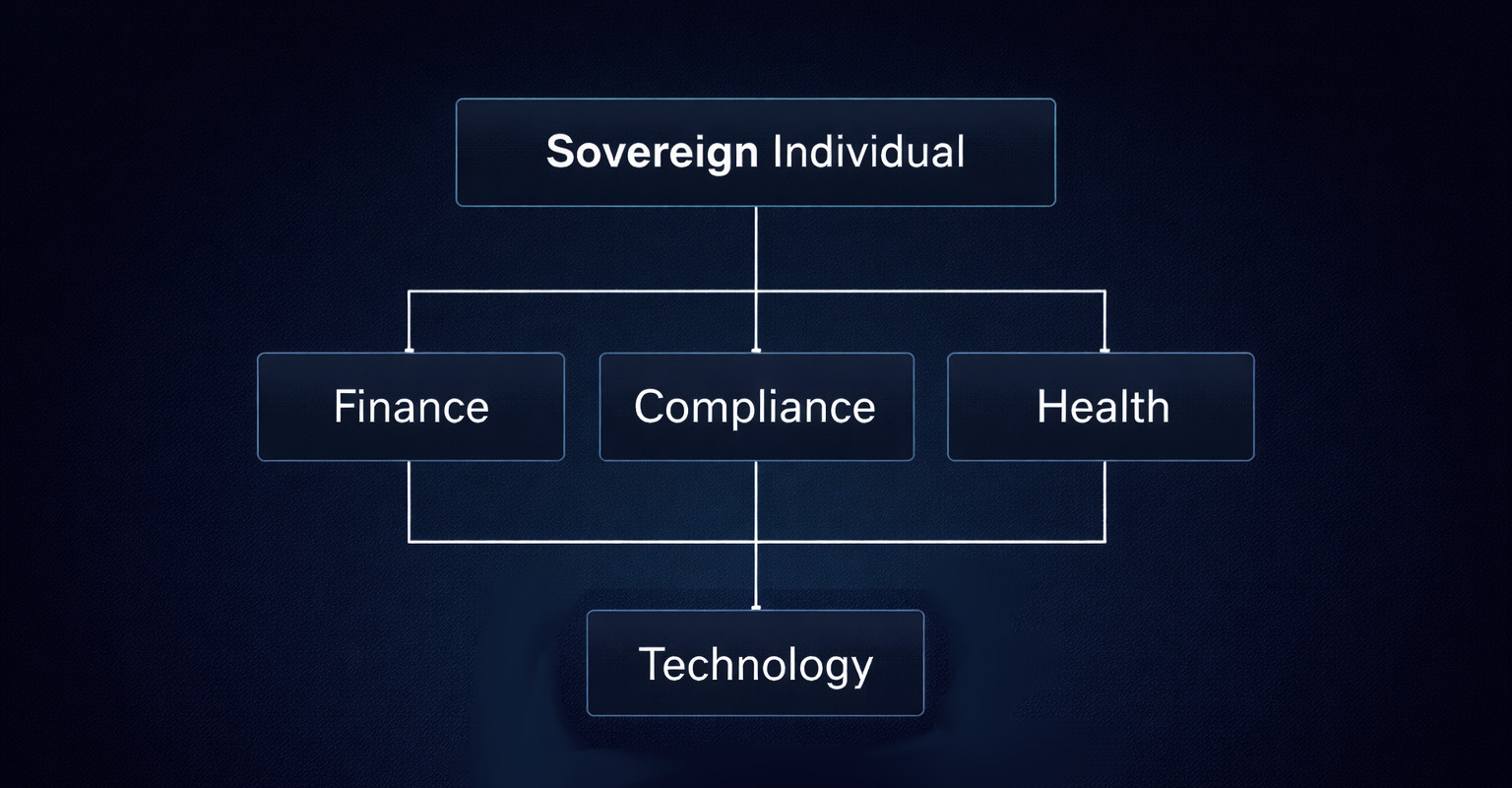
What I found myself building -- first for survival, then for independence -- were systems for navigating complexity: financial systems, administrative systems, digital systems, technological systems, and increasingly, systems of autonomy.
This is ultimately what Incubiq explores: systems for remaining self-sovereign in a world where change accelerates, compliance expands, freedoms tighten, and genuine independence becomes harder to achieve.
The technologies enabling self-sovereignty
If you feel this tension too -- welcome. You are exactly where this journey begins: learning how to build an operating system for maintaining your own sovereignty in an increasingly complex world.
Two technological shifts are now making this possible at a scale that did not exist before: blockchain and artificial intelligence. I began exploring both around 2020. Since then it has become increasingly clear to me that they represent foundational layers for individual agency. Used well, they allow individuals to reclaim control -- over assets, decisions, and systems. Ignored, they will likely become the opposite: powerful instruments for corporations, governments, and other large structures to tighten their grip on the individual.
Like many transformative technologies before them, they are double-edged. Used deliberately, they expand freedom. Ignored, they quietly concentrate power elsewhere.
In simple terms, their roles can be understood as follows:
-
Blockchain -- the infrastructure for self-sovereignty. It allows individuals to retain direct ownership of assets, identities, and transactions without relying entirely on intermediaries. More broadly, it provides the infrastructure layer through which autonomous systems -- including future AI systems -- can operate independently.
-
Artificial Intelligence -- the amplifier of individual capability. AI systems dramatically extend the cognitive and operational capacity of individuals, allowing one person to perform work that previously required entire organisations.
Together, blockchain and AI open the door to a new archetype: the self-sovereign individual.
For each of us, the question increasingly becomes unavoidable: do you build your own systems of autonomy? Or do you remain fully dependent on institutional systems designed for managing large populations rather than empowering individuals?
This publication explores the systems required for the first path.
The architecture of personal sovereignty
They fall broadly into five domains:
- The Sovereign Individual Framework -- sovereignty, resilience, complexity
- Financial Intelligence Systems -- markets, trading, capital resilience
- Bureaucratic Intelligence -- cross-border, compliance, legal
- AI & Personal Infrastructure -- AI agents, automation, personal systems
- The Sovereign Tech Stack -- identity, crypto, tooling
The systems that shape modern life are not disappearing. If anything, they are becoming more complex, more interconnected, and more powerful. The individuals who remain resilient in the decades ahead will not simply be those with knowledge or capital, but those who understand how to build and operate systems of their own:
- Financial systems.
- Health systems.
- Administrative systems.
- Technological systems.
- Decision systems.
Over time, sovereignty increasingly belongs to those who build them. This publication explores how -- not as theory, but as architecture, one system at a time.